
401(k) Rollover After Job Change: 4-Step Guide
401(k) & IRA Rollovers After a Layoff or Job Change: Your 4-Step Playbook
A job change is stressful enough. Your retirement account should not add to that stress. Whether you left by choice, took a new offer, or faced a layoff, the money in your old 401(k) still belongs to you. What you do next can either protect that balance or create an unexpected tax bill.
This guide walks through your options in plain English. You will see how a direct rollover works, why the 60-day rule matters, what the IRS withholds on indirect rollovers, and a simple four-step playbook you can follow this week. Cross Point Solutions, founded by Zina Smith in Columbia, Maryland, helps families and professionals make these decisions with clear education first.
Why your old 401(k) needs a decision
When you leave an employer, your 401(k) does not vanish. Most plans let you leave the money where it is if your balance meets the plan’s minimum. That is one option. It is not always the best one.
Common reasons people move their money:
They want one account instead of several old plans scattered across past jobs.
The old plan has higher fees or fewer investment choices than they want.
They prefer to choose their own IRA custodian and investment mix.
They are consolidating before retirement so required minimum distributions, and beneficiaries are easier to manage later.
Some people keep money in the old plan when fees are low, funds are strong, or they simply need time before they choose. There is no single right answer. The goal is an intentional choice, not a default, because the paperwork felt hard.
Your four main choices for an old 401(k)
Most people face four paths:
Leave it in the old employer plan (if allowed).
Roll it into your new employer’s 401(k) (if the new plan accepts rollovers).
Roll it into an IRA (traditional or Roth, depending on the type of money).
Cash it out (usually the most expensive path under age 59½).
Cashing out turns retirement money into current income. You may owe ordinary income tax plus an extra 10% early distribution tax if you are under 59½, with limited exceptions. For most working-age people, cashing out is the option to avoid unless there is a true emergency and no better source of cash.
Federal employees with a Thrift Savings Plan have a related set of choices when they leave service. If that is you, read our companion guide on TSP rollover options when you leave federal service.
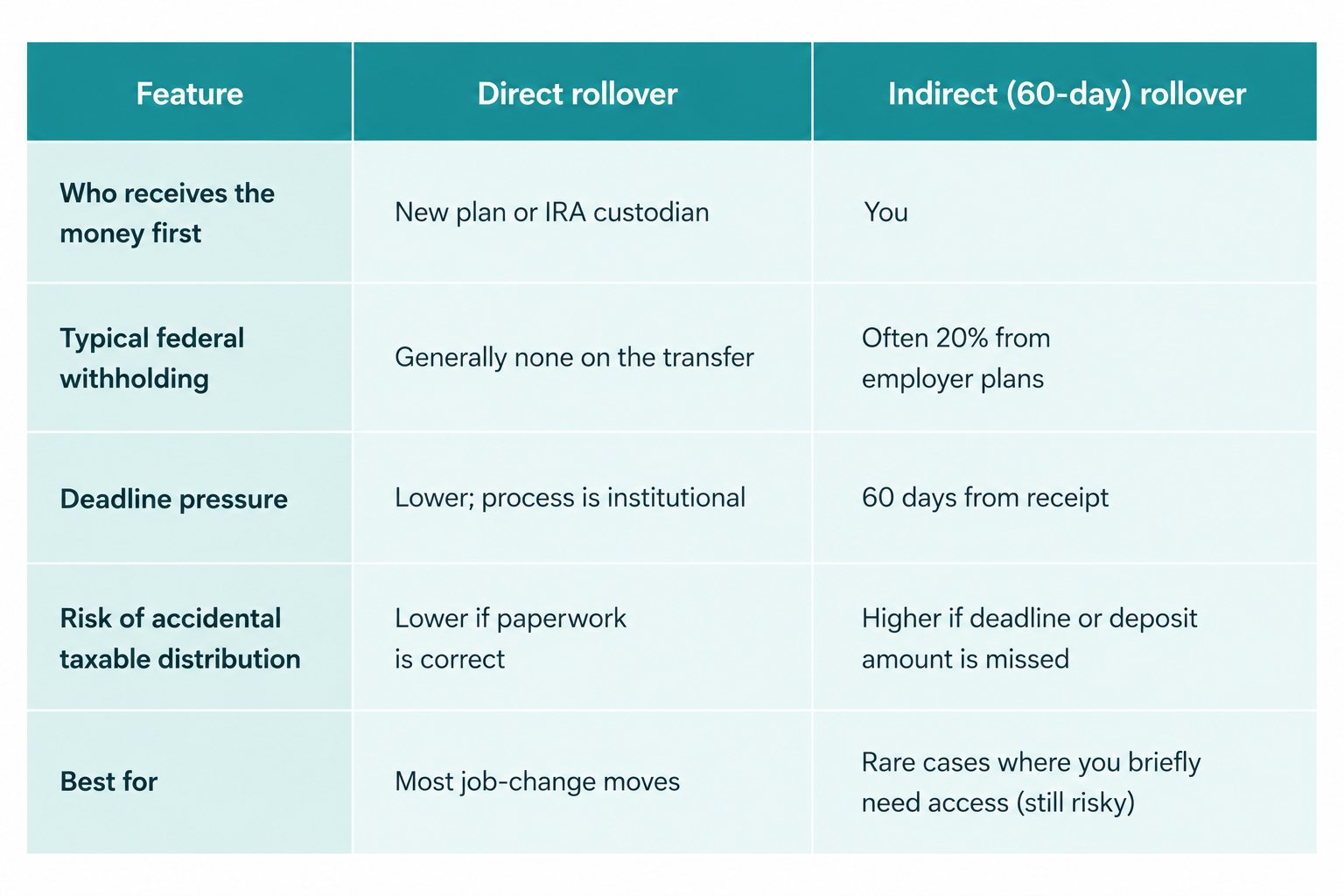
Direct rollover vs indirect rollover
This is the most important technical distinction in the whole process.
Direct rollover (trustee-to-trustee)
In a direct rollover, you ask the old plan to send the money straight to the new plan or IRA. The check is often made payable to the new custodian for your benefit, or the funds move electronically. You never take personal possession of the money as a usable paycheck.
According to the IRS rollover guidance, a direct rollover from a retirement plan to an eligible plan or IRA generally has no mandatory tax withholding on the transferred amount. That keeps the full balance working for you.
Indirect rollover (60-day rollover)
In an indirect rollover, the plan pays you first. You then have 60 days from the date you receive the distribution to deposit the money into another eligible retirement account if you want the move to count as a rollover rather than a taxable distribution. The IRS explains this timeline in Topic No. 413, Rollovers from retirement plans
Here is the trap many people miss. For eligible rollover distributions paid to you from an employer plan, the payer generally must withhold 20% for federal income tax. If your balance was $50,000, you might receive about $40,000 and see $10,000 withheld. To complete a full rollover of the entire $50,000, you must deposit the $40,000 plus $10,000 from other savings within 60 days. You can later recover the withheld amount as a credit when you file your tax return if the rollover was completed correctly, but you still had to come up with the shortfall up front.
That is why most people should choose a direct rollover when the goal is simply to move retirement money from Point A to Point B.
Traditional vs Roth money
Not all 401(k) dollars are the same for tax purposes.
Pre-tax (traditional) 401(k) money usually rolls to a traditional IRA or to the pre-tax side of a new 401(k) without current income tax when done as a proper rollover.
Roth 401(k) money generally rolls over to a Roth IRA or Roth account in a new plan. Moving Roth money into a traditional account is not the normal path and can create tax issues.
After-tax (non-Roth) contributions inside some plans have special rollover rules. The IRS has separate guidance on rollovers of after-tax contributions. If your statement shows after-tax basis, get help before you move anything.
A Roth conversion is different from a same-tax-character rollover. Converting pre-tax money to a Roth IRA means you include the converted amount in taxable income that year. Do that on purpose, not by accident, on a job-change form.
The 4-step playbook
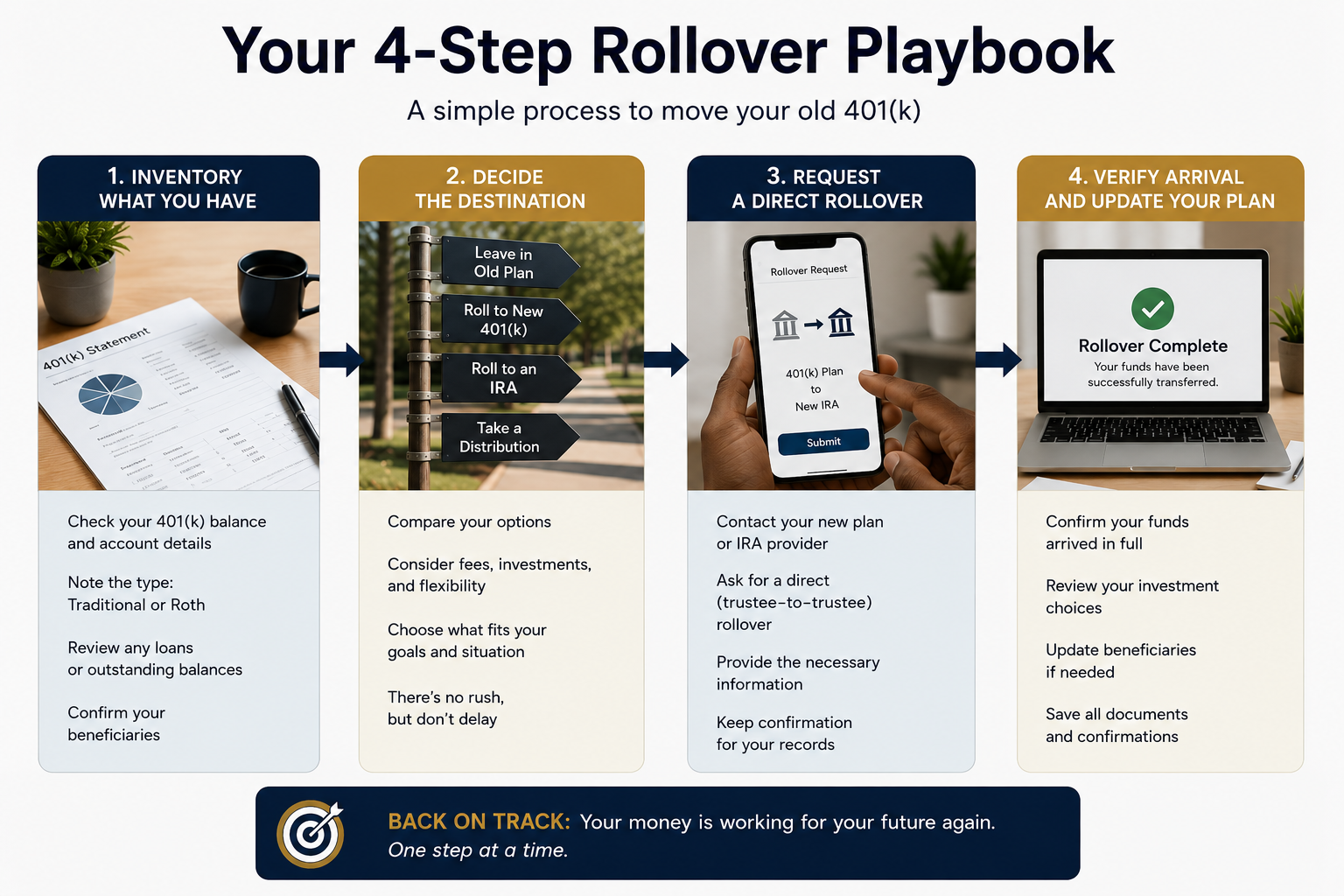
Step 1: Inventory what you have
Before you call anyone, gather:
Your latest 401(k) statement (balance, fund list, pre-tax vs Roth vs after-tax).
Whether you are fully vested in employer contributions.
Outstanding plan loans (leaving a job with an unpaid loan can trigger a taxable distribution of the unpaid balance under many plans).
Employer stock or special holdings that may have unique tax treatment.
Beneficiary designations on file.
Write down the plan administrator's phone number and your participant ID. Ten minutes of organization saves hours of hold music later.
Step 2: Decide the destination
Ask three questions:
Does my new employer’s plan accept rollovers, and are the fees and funds better than what I have?
Do I want the simplicity and investment flexibility of an IRA?
Am I close enough to retirement that consolidating accounts will make income planning easier?
If you are also building permanent protection and tax-free access strategies alongside workplace plans, our guide on how IUL and a 401(k) can work together explains how those tools differ and when people use both.
Step 3: Request a direct rollover in writing
Contact the old plan and say clearly that you want a direct rollover (trustee-to-trustee) to your new account. Open the receiving IRA or confirm the new 401(k) rollover instructions first so you have the exact payee name, account number, and mailing or wire details.
Confirm:
The check is not made payable solely to you personally if you intend a direct rollover.
Pre-tax and Roth amounts are directed to the correct receiving account types.
You receive written confirmation of the distribution codes and amounts for your tax records (Form 1099-R will arrive later).
Step 4: Verify arrival and update your plan
When the money lands:
Confirm that the full expected amount has arrived.
Invest the cash according to your allocation. A rollover that sits in a settlement fund for months is an incomplete job.
Update beneficiaries on the new account.
Save the 1099-R and any trustee paperwork with your tax documents.
If you completed an indirect rollover, track the 60-day window carefully and keep proof of the deposit date.
The IRS may grant waivers of the 60-day requirement in limited hardship situations. Details are on the IRS page for waivers of the 60-day rollover requirement. Do not plan on a waiver. Plan on a direct rollover instead.
What about contribution limits after you land the new job?
A rollover does not use up your annual employee deferral limit. For 2026, the IRS set the basic elective deferral limit at $24,500 for 401(k)-type plans, with additional catch-up amounts for eligible ages. See the IRS announcement on 2026 401(k) and IRA limits and the broader page on 401(k) contribution limits.
Once you enroll in the new plan, set your deferral percentage on day one if you can. Job changes are one of the most common times people accidentally pause retirement savings for months.
How this fits a full retirement picture
A clean rollover protects what you already built. It does not replace a full plan for income, health coverage, or family protection. Federal employees should also review pension timing in our FERS retirement guide. Zina Smith, a licensed insurance professional and founder of Cross Point Solutions in Columbia, Maryland, helps families and professionals understand the moving pieces, then choose what fits: Contact
Quick checklist you can screenshot
Do not cash out unless you fully understand taxes and penalties.
Prefer a direct rollover over a check payable to you.
Match traditional money to traditional accounts and Roth money to Roth accounts unless you intentionally convert.
Resolve plan loans before or during the exit process.
Confirm the full balance arrived and reinvest it.
Update beneficiaries.
Keep 1099-R and rollover confirmations for your tax file.
Ready for a clear next step?
If you are changing jobs, managing a layoff, or staring at an old 401(k) statement you have ignored for years, you do not have to sort the forms alone. Book a complimentary conversation, and we will walk through your options in plain English.
Schedule your free consultation with Cross Point Solutions. Bring your latest statement if you have it. We will help you map a direct path that protects what you have already earned.
Prefer to prepare on your own first? Start with the free retirement checklist, then book time when you are ready.
Disclaimer: This article is for educational purposes only. It is not financial, legal, tax, or investment advice. Rules for retirement plans, withholding, penalties, and exceptions depend on your personal situation and current law. Consult a qualified tax professional, attorney, or financial professional before you act. Cross Point Solutions and Zina Smith do not provide tax or legal advice.