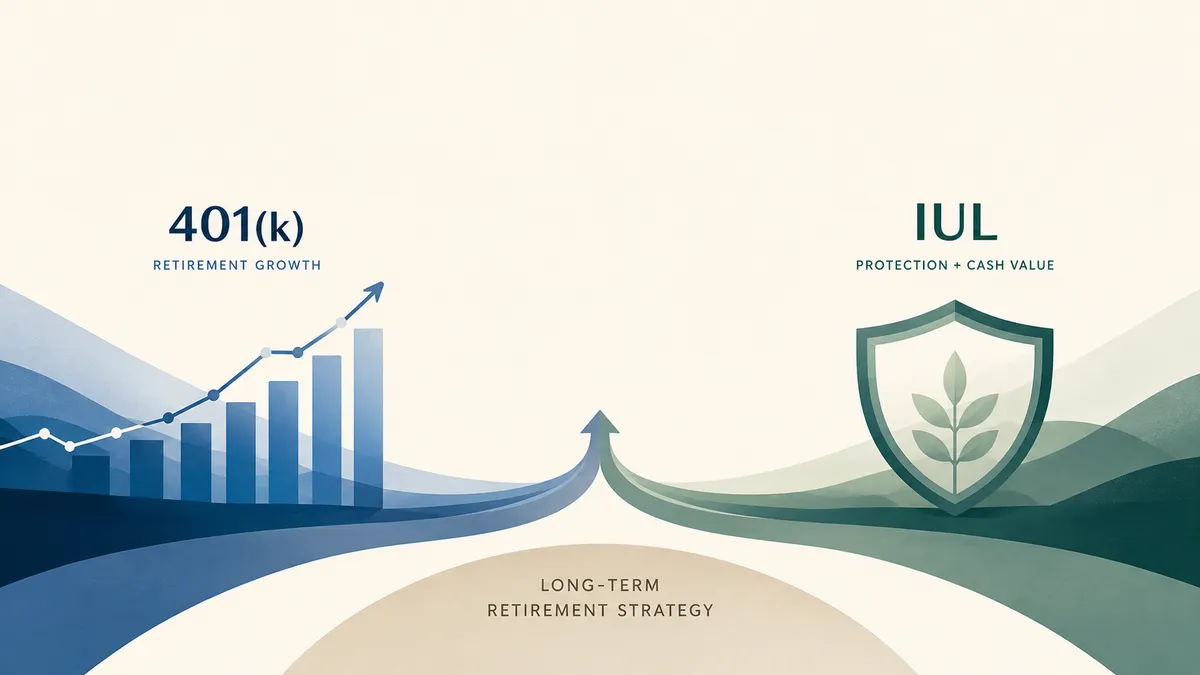
IUL vs 401(k): How They Work Together
Indexed Universal Life (IUL) vs. 401(k): How They Work Together for Retirement
People often ask which is better: an Indexed Universal Life policy or a 401(k). That question assumes you must pick one. For many families and professionals, the stronger answer is different. Use each tool for what it does well, and build a retirement plan that is not tied to a single tax bucket or a single type of market risk.
This article explains both products in plain English, compares them side by side, and shows how they can sit together in one plan. Cross Point Solutions, led by founder Zina Smith in Columbia, Maryland, teaches these concepts so you can decide with clear information rather than pressure.
For a free self-check while you read, grab the Retirement Readiness Checklist
What a 401(k) is built to do
A 401(k) is a workplace retirement plan. You contribute from your paycheck, often before tax (traditional) or after tax as Roth if your plan offers it. Many employers add a match. Investments sit inside the plan in mutual funds, target-date funds, or similar options the plan menu allows.
Key traits of a typical 401(k):
Contributions can lower your taxable wages today (traditional deferrals).
Growth is tax-deferred (traditional) or potentially tax-free later (Roth, if rules are met).
There are annual contribution limits set by the IRS.
Investments can rise and fall with the markets. There is no built-in 0% floor on stock funds.
Withdrawals before 59½ often face income tax plus an extra 10% tax, with important exceptions.
Required minimum distributions generally apply later in life for traditional balances (Roth 401(k) rules have changed over time; confirm current law for your situation).
For 2026, the IRS announced a basic elective deferral limit of $24,500 for 401(k)-style plans, with catch-up amounts for eligible participants. Details are in the IRS newsroom release on 2026 contribution limits and the IRS page on 401(k) and profit-sharing limits.
If you change jobs, the account does not disappear. You choose whether to leave it, roll it to a new plan, roll it to an IRA, or cash it out. Our playbook on 401(k) and IRA rollovers after a job change covers that process step by step.
What an IUL is built to do
Indexed Universal Life is a type of permanent life insurance. It has two core jobs:
A death benefit that can help protect the people who depend on you.
A cash value account that can grow based in part on the performance of a market index (such as a major stock index), subject to the policy’s rules.
You do not invest the cash value directly in the stock market inside a standard IUL design. The insurer credits interest using a formula tied to an index. That formula usually includes:
A floor (often 0%) so index-linked interest is not negative in a down year for that crediting method.
A cap or other limit on how much index-linked interest you can be credited in a strong year.
A participation rate or other factors that shape how much of the index move counts.
Policy charges still apply. Cost of insurance, administrative charges, and riders affect results. An IUL is a long-term contract, not a short-term trading account. Illustrations are not guarantees of future crediting.
Access to cash value is commonly discussed through withdrawals and policy loans. Carriers and educators generally note that loans and withdrawals, when structured carefully and when the policy stays in force, are often received income-tax free under current rules, and the death benefit is generally income-tax free to beneficiaries. Loans reduce the death benefit and can cause a policy to lapse if not managed. A lapse with an outstanding loan can create a tax surprise. This is why ongoing policy reviews matter.
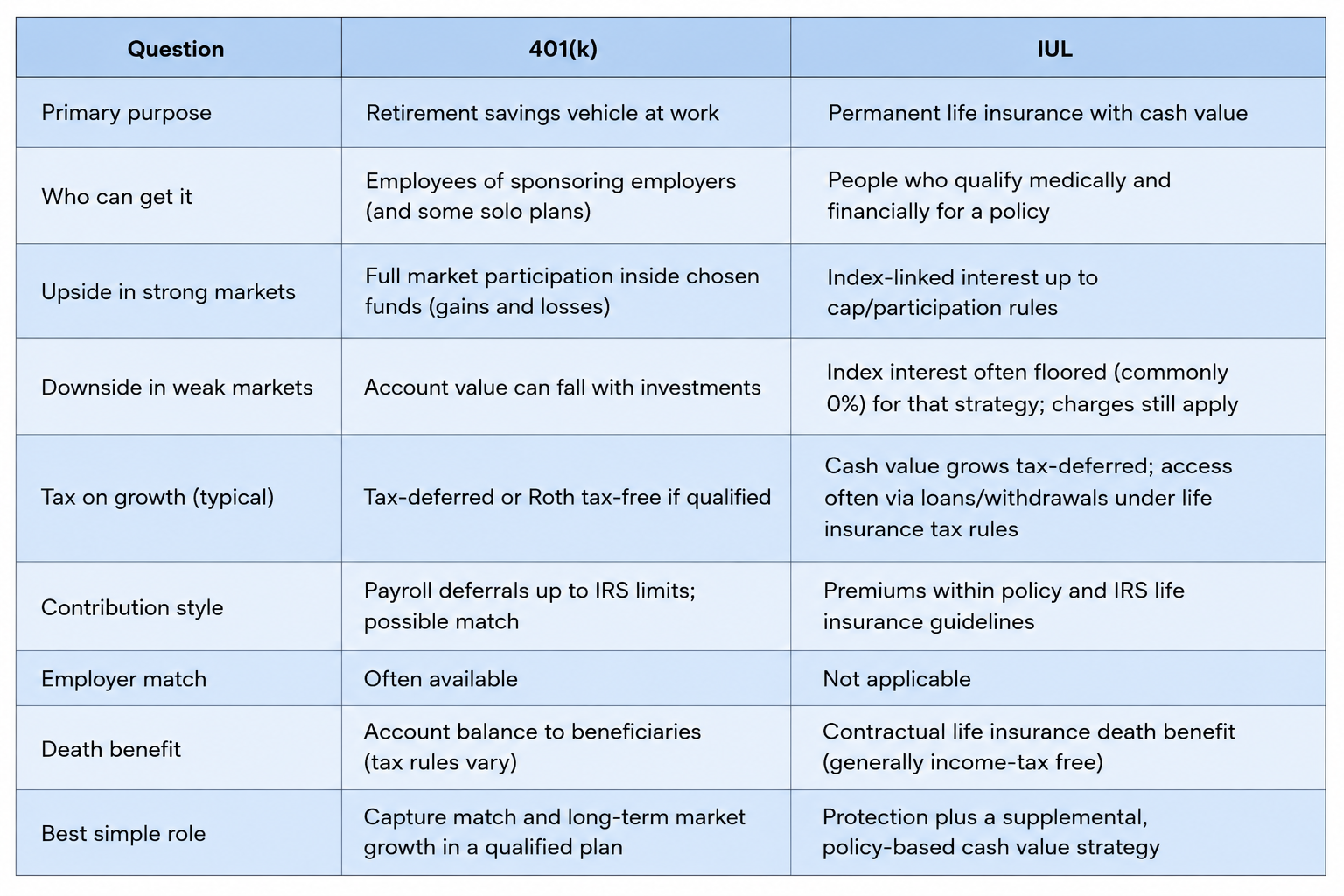
Side-by-side comparison
Why “versus” is often the wrong frame
A 401(k) shines at workplace savings discipline and, when a match exists, free employer money. Turning down a full match to buy something else is rarely the first move. Maximizing every possible financial product at once is also rarely required.
An IUL shines at something a 401(k) is not: a permanent death benefit paired with a cash value design that uses floors and caps rather than direct market ownership. Families who want protection for a spouse or children, and who also want another way to access value later, study IUL for that combined job.
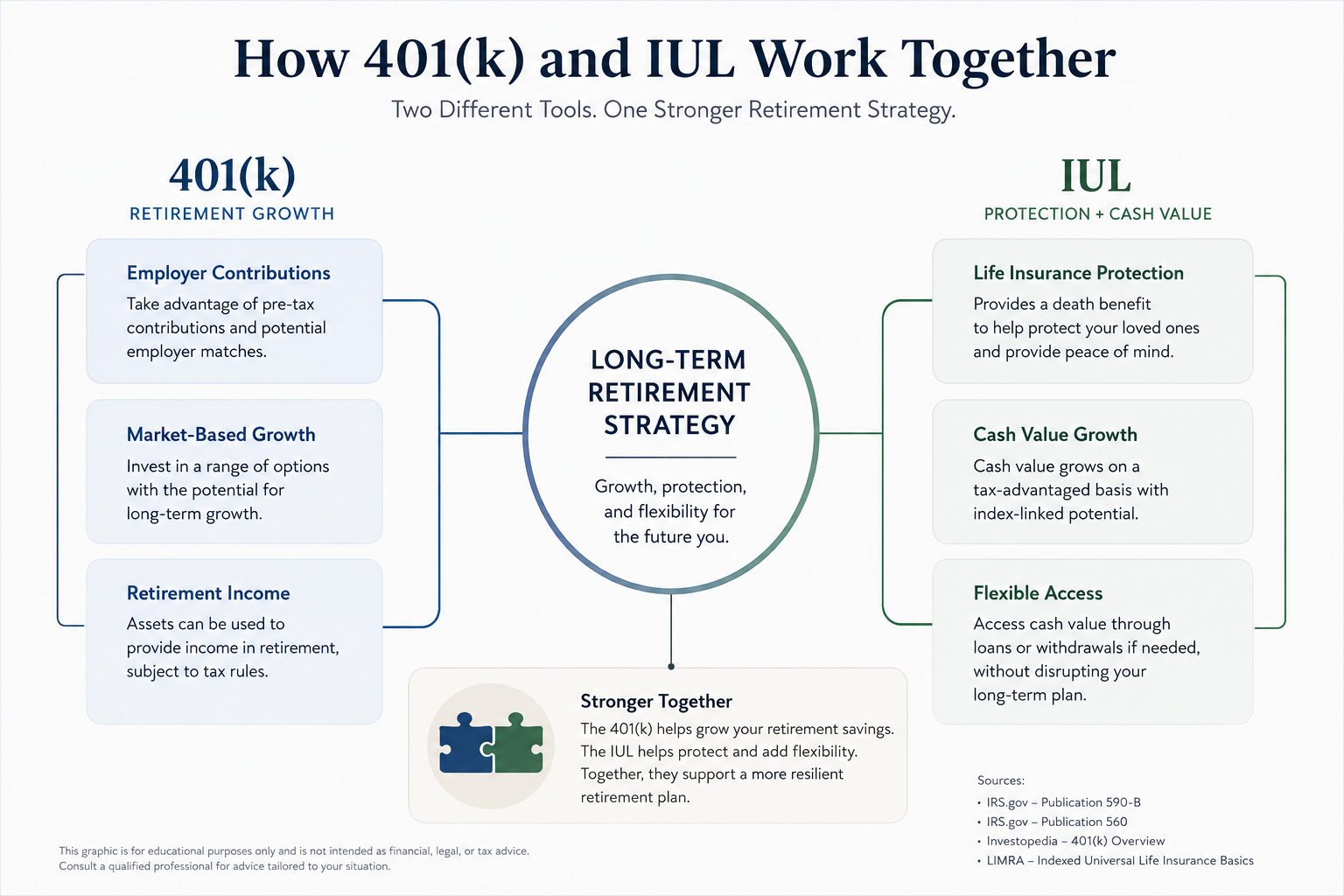
Used together, a common pattern is: capture the full 401(k) match, build emergency cash, pay down high-interest debt, raise retirement savings toward your target, then add a carefully designed IUL only if cash flow, underwriting, and family goals support it. Order matters. Insurance does not replace an emergency fund, and a 401(k) does not replace life insurance if someone depends on your income.
Taxes: different buckets, different rules
Think in tax buckets rather than product slogans.
Bucket A: Tax-deferred workplace and IRA money. Traditional 401(k) and traditional IRA dollars often reduce taxable income going in and are taxed as ordinary income coming out (with exceptions and ordering rules).
Bucket B: Roth workplace and Roth IRA money. You pay tax on contributions up front (or on conversions), and qualified withdrawals can be tax-free later.
Bucket C: Life insurance cash value and death benefit. Properly structured permanent life insurance has its own tax framework under the Internal Revenue Code. Death benefits are generally income-tax free. Cash value access through loans is commonly not treated as taxable income while the policy remains in force, subject to important limits (including modified endowment contract rules if a policy is overfunded too quickly).
In retirement, more than one way to draw money can help if tax rates change or a large traditional balance would push you into a higher bracket. That is coordination, not magic.
Risk: what each tool exposes you to
401(k) market risk. Stock funds can fall in the year you retire. Diversification helps but does not remove sequence-of-returns risk.
IUL crediting and product risk. Caps and crediting methods can change within policy rules. Charges continue in low-crediting years, so thin funding can still pressure cash value. Illustrations are teaching tools, not promises. Carrier strength and design quality matter.
Protection risk. A 401(k) can be spent down. A death benefit exists because someone may depend on your income. That is a different job than accumulation alone.
Liquidity and access before traditional retirement age
401(k) access before 59½ is restricted. Hardship rules, loans (if allowed), and separation exceptions exist, but they are not a free ATM. Rolling to an IRA changes which exceptions apply. IUL access depends on cash value, early surrender charges, and loan rules. If you need every dollar liquid in year two, a permanent life policy is the wrong tool for that dollar.
How federal employees and career changers fit in
Federal employees often hold a TSP alongside FERS benefits. Secure workplace savings and pension rules first, then evaluate personal insurance. Start with the FERS retirement guide and the TSP rollover options article if you are leaving service. Private-sector professionals with old 401(k)s may consolidate first, then decide whether permanent life insurance belongs in the plan.
Practical questions to ask before you add an IUL beside a 401(k)
Do I already contribute enough to get the full employer match?
Do I have three to six months of expenses in safe, accessible savings?
Who depends on my income, and how much death benefit do they need?
How long can I commit to funding a policy without raiding it early?
Am I comfortable with caps, floors, and illustrated scenarios that are not guarantees?
Have I compared policy designs and carrier strength rather than a single sales illustration?
How will loans, if used later, be managed so the policy stays healthy?
If any answer is unclear, pause. Education first means you understand the tradeoffs before you sign.
Common myths to drop
Myth: “IUL replaces my 401(k).” It does not replace an employer match or workplace contribution room.
Myth: “My 401(k) is all the life insurance my family needs.” A retirement balance is not a contractual death benefit sized to replace income or cover a mortgage.
Myth: “Floors mean IUL cash value can never go down.” Index interest may be floored, but policy charges and thin funding can still reduce cash value.
Myth: “I should wait until I max every retirement account before protection.” If someone depends on your paycheck, protection timing is about risk today, not only optimization later.
How Cross Point Solutions approaches this conversation
Cross Point Solutions works with families, professionals, and business owners who want plain-English explanations of retirement and protection tools. We will not claim one product solves every problem. We help you see where a 401(k), an IRA, a pension, or TSP, and life insurance each earn a place, if they earn a place for you.
Next steps
If you want help mapping your workplace plan to your protection needs, schedule a complimentary conversation. Bring a recent 401(k) or TSP statement and any life insurance you already own.
Book your free consultation with Cross Point Solutions. We will walk through your numbers in everyday language and outline options that fit your goals.
Want a head start before we meet? Download the free retirement checklist and note your current deferral rate, match, and any coverage gaps.
Disclaimer: This article is for educational purposes only. It is not financial, legal, tax, investment, or insurance advice. Life insurance and retirement plan rules depend on your facts, policy contracts, plan documents, and current law. Illustrations are not guarantees. Consult qualified tax, legal, and financial professionals before you buy, surrender, roll over, or borrow against any account or policy. Cross Point Solutions and Zina Smith do not provide tax or legal advice. Product availability and features vary by carrier and state.