
TSP Rollover Options: What to Do With Your Account When You Leave Federal Service
When you leave federal service, your Thrift Savings Plan does not vanish. If your balance is $200 or more, you can keep it in the TSP, roll it to an IRA or a new employer plan, convert to Roth, or take a distribution. Direct rollovers avoid mandatory 20% withholding. The right move depends on costs, taxes, income needs, and whether you want options outside the TSP fund menu.
This guide walks through each path in plain English so you can decide with a clear head, not a sales pitch.
What Happens to Your TSP When You Leave?
Separation ends new employee contributions and agency matching. It does not automatically cash you out.
According to the official TSP guidance on leaving federal service
• Balances of $200 or more can stay in the TSP
• You can still change your investment mix
• You can still transfer eligible money into the TSP
• You keep access to the plan’s low administrative costs while the account remains invested
• You should keep your address current and resolve any TSP loans
TSP’s withdrawals-in-retirement pages cover installments, partial withdrawals, and rollovers out after you separate. Read the tax materials on tsp.gov before you submit anything. Tax mistakes are expensive and often permanent.
For how the TSP sits next to your FERS pension, start with our FERS Retirement Guide and our federal employee resources on the site: Cross Point Solutions.
Option 1: Leave It in the TSP
Why people stay:
• Expense ratios are among the lowest in the industry
• The G Fund structure is unique
• Installment payments can create a simple paycheck-like stream
• Familiar fund lineup (G, F, C, S, I, and L Funds)
Why people leave:
• Limited menu if you want broader investments or certain income products
• Harder for an outside advisor to manage holdings inside the TSP
• No new employee contributions after separation
• Estate and distribution preferences sometimes fit better in an IRA
Option 2: Roll Over to a Traditional IRA
A direct Traditional IRA rollover moves pre-tax TSP money to another pre-tax IRA. Done correctly, it is not a taxable distribution.
Advantages:
• Wider investment choice
• Easier coordination with a licensed professional when that is part of your plan
• Ability to consolidate old workplace plans
• Flexible beneficiary and distribution design
Trade-offs:
• Retail IRAs often carry higher fund or advisory fees than the TSP
• You give up TSP-only features such as the G Fund
• Creditor protection and state rules can differ from the federal plan
Tax rules for federal retirement distributions are covered in IRS Publication 721. Required minimum distributions still apply to traditional balances under current federal RMD ages. Confirm the age that applies to your birth year.
If a private-sector job change or layoff is driving the same kind of decision for you, see our 401(k) and IRA rollover resource: 4O1(k) resources.
Option 3: Roll Over to a Roth IRA (Conversion Path)
Moving pre-tax TSP money into a Roth IRA generally means paying tax on the converted amount in the year of the conversion. After that, qualified Roth withdrawals can be tax-free under IRS Roth rules,
When people consider it:
• They expect higher tax rates later
• They want tax-free growth for heirs under current law
• They have cash outside the account to pay the tax bill (so they do not shrink the rollover)
When people pause:
• A large conversion can push ordinary income into higher brackets
• Medicare IRMAA and other income-based thresholds can be affected in later years
• Paying tax from the conversion itself reduces what stays invested
This is a planning conversation, not a checkbox.
Option 4: Roll Into a New Employer’s Plan
If your next employer accepts rollovers, you may move TSP money into that 401(k) or similar plan.
Possible upsides: fewer accounts, loan features in some plans, creditor protection under ERISA for many plans.
Possible downsides: higher fees, weaker fund menu, waiting periods, limited distribution flexibility while employed.
Always request the new plan’s fee disclosure and fund list before you move a dollar, and involve a licensed financial advisor if the terms are unclear to you.
Option 5: Take a Distribution (Cash Out)
Cashing out is almost never the default “best” move for long-term retirement money. It can trigger ordinary income tax and, if you are under 59½, a 10% additional tax in many cases, with limited exceptions. See IRS Topic 558 on early distributions. If you need bridge income, look first at installment options inside the TSP, partial withdrawals, or a planned rollover plus a smaller, intentional distribution, with tax help.
Direct vs. Indirect Rollover
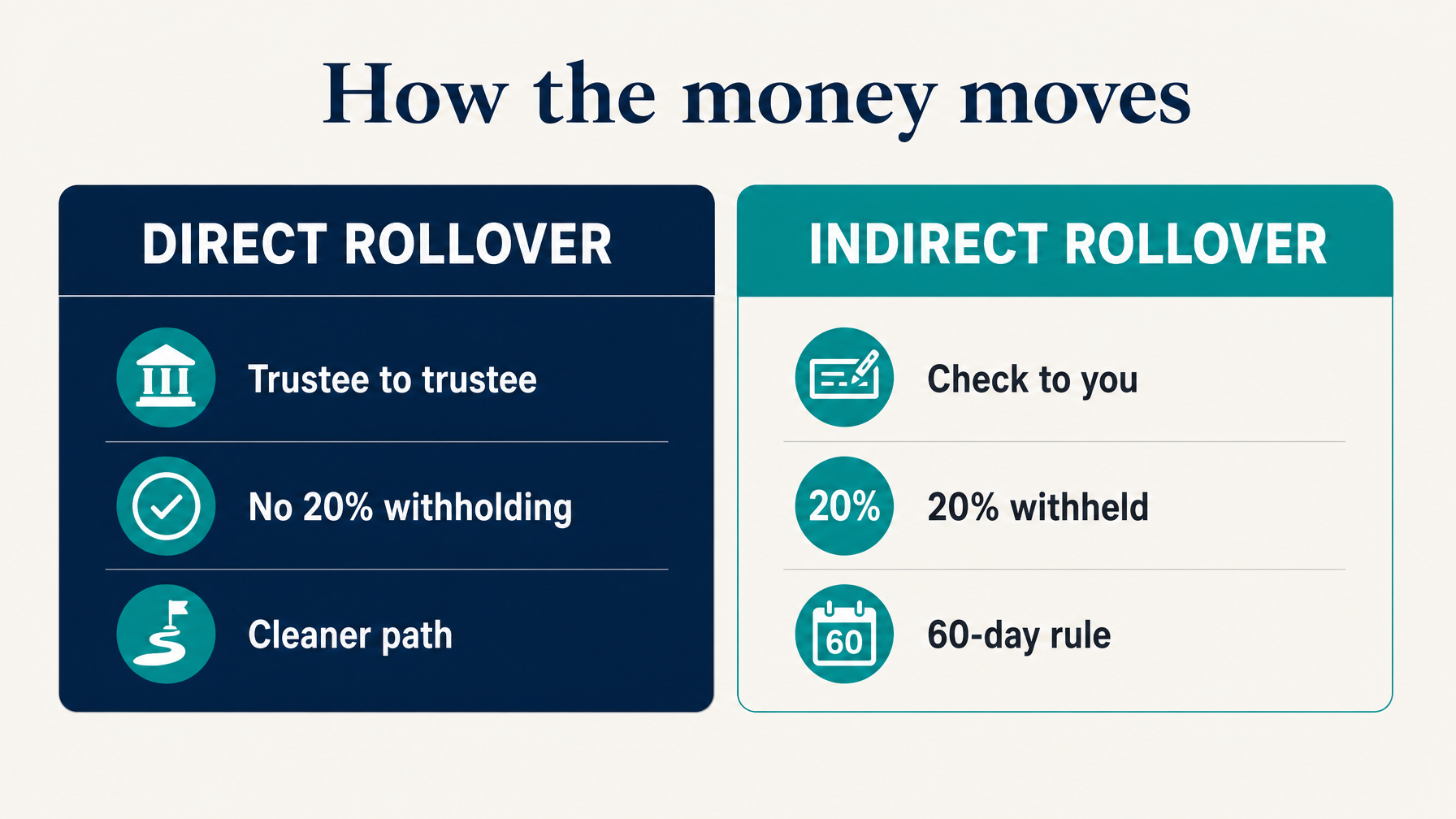
Direct rollover: the TSP sends funds to the new IRA or plan trustee. No mandatory 20% federal withholding on the rollover amount when done correctly.
Indirect rollover: the TSP pays you. By default, 20% federal tax may be withheld. You typically have 60 days to deposit the full amount (including replacing the withheld 20% from other cash) into an eligible account to complete a nontaxable rollover. Miss the window, and it can become taxable.
Direct is almost always cleaner. Details live in TSP withdrawal materials and IRS rollover publications.
Loans, Beneficiaries, and Housekeeping
Before or right after separation:
1. Resolve TSP loans. Unpaid loans can be treated as taxable distributions after separation.
2. Update beneficiaries. Beneficiary forms override your will for that account.
3. Confirm your mailing address and login access while you still remember your credentials.
4. Download recent statements and transaction history for your records.
5. If you keep FEHB into retirement, confirm the five-year rule and coordination with your agency's HR.
How to Decide (A Simple Filter)
Ask, in this order:
1. Do I need this money for income in the next 1-5 years?
2. Are my all-in costs lower inside the TSP or outside it?
3. Do I need investments or income tools that my TSP cannot offer?
4. What is my tax picture this year vs later (including Roth ideas)?
5. Who will help me coordinate pension, Social Security, and withdrawals so they do not collide?
If you want a calm second set of eyes, book a free conversation with Cross Point Solutions. We educate first. No pressure on the first call.
You can also start with our Federal Employee Retirement Checklist and learn more about who we are on the About page.
The Bottom Line
Leaving federal service is a career change and a money-structure change. Your TSP can stay put, move carefully, convert with a tax plan, or, in rare cases, be withdrawn with eyes wide open. The expensive mistakes are rushed indirect rollovers, ignoring loans, and treating a cold call as your only education.
Read tsp.gov. Confirm taxes with our tax professional when numbers get large. Build a written plan before you click submit.
Educational only. Not financial, tax, or legal advice. Rules change. Confirm with TSP.gov, IRS, your agency HR, OPM, and licensed professionals before acting.